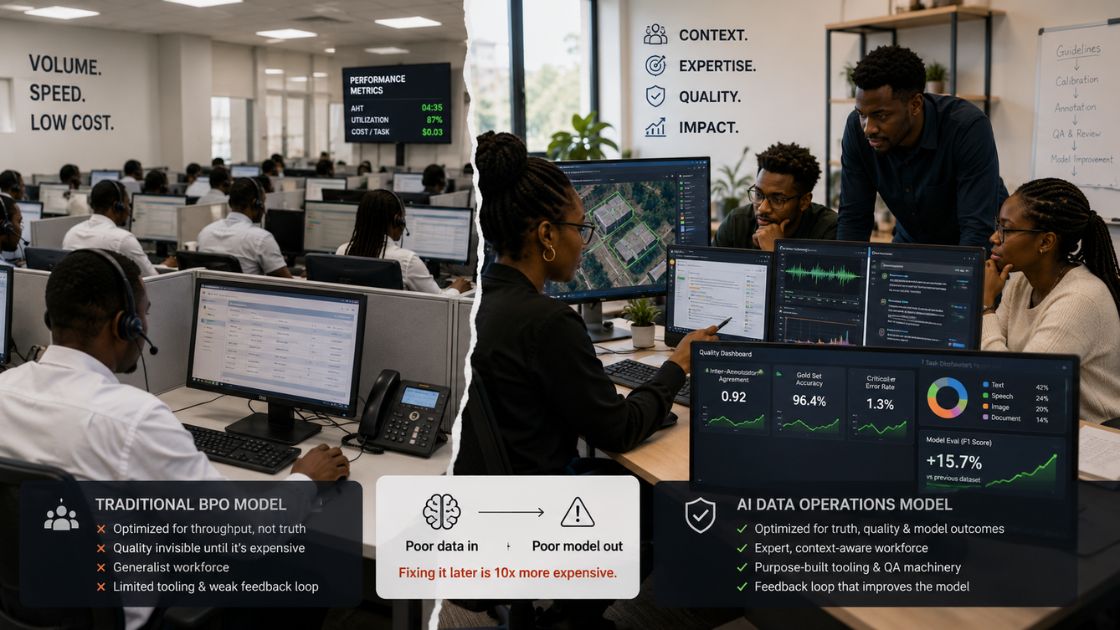
Almost every enterprise AI team reaches a critical decision point: models need training data, the internal team cannot label it fast enough, and procurement suggests the obvious answer. They point to the BPO vendor the company already uses for customer support, back-office processing, or document handling.
On paper, it makes sense. BPOs have people, seats, security certifications, and an existing MSA. Annotation looks like just another volume task.
It is not. The teams that treat it that way usually discover the true cost twelve months later inside the model, where it is most expensive to fix.
Having spent years inside data sourcing and annotation operations for AI Labs, here is what we see go wrong when traditional BPOs take on AI data work, alongside what you should look for instead.
Risk 1: The Incentive Model Is Built for Throughput, Not Truth
Traditional BPOs are engineered around a specific economic logic: maximize handled volume per seat per hour. Every operational metric, including average handle time, utilization, and cost per transaction, pushes toward speed.
AI data annotation inverts that logic. A dataset labeled 20% faster but 5% less accurately is not just slightly worse; it can result in a materially worse model. Errors in training data compound. The model learns the mistakes, evaluation sets inherit the same errors and fail to catch them, and fine-tuning on top of noisy labels amplifies rather than corrects the drift.
When the vendor's commercial model rewards volume and the client's outcome depends on precision, the misalignment is structural. No SLA fixes an incentive problem.
Risk 2: Annotation Quality Is Invisible Until It's Expensive
If a BPO mishandles a customer support ticket, you know within hours. If a BPO mislabels 8% of your training data, you find out after you have trained the model, run evaluations, shipped to a pilot customer, and started debugging why production performance doesn't match the benchmark.
By that point, the remediation cost is no longer just redone labels. Instead, you must audit the entire dataset, identify systematic error patterns, relabel, retrain, re-evaluate, and re-earn the internal credibility the AI team just spent. Data quality failures are unique because they are cheap to create and extremely expensive to discover.
Specialist data operations counter this with inter-annotator agreement tracking, gold-set audits, calibration sessions, and statistically sampled QA. These are disciplines that simply do not exist in a call-center operating model because nothing in that model ever required them.
Risk 3: Generalist Workforces Cannot Supply Context
This is the risk that matters most for anyone building AI for African markets. Modern annotation is judgment work. Rating whether an LLM's response is culturally appropriate, transcribing code-switched Yorùbá–English speech, deciding whether a loan document field is ambiguous, or evaluating whether a model's Swahili is fluent or merely grammatical cannot be done by a generalist agent following a script.
Traditional BPOs staff by availability rather than linguistic or domain qualification. A team that handled telecom billing disputes last quarter gets assigned to your speech data this quarter. The result is data that looks complete in the delivery report but hollow in the model, giving you the correct format but the wrong judgment.
We highlighted one dimension of this in our African Language Tax research. Models systematically underperform in African languages partly because the data behind them was never built by people with native command of those languages. A BPO cannot fix a context problem with headcount. Context is not a volume input; it is the product itself.
Risk 4: The Tooling Gap Becomes Your Engineering Problem
Serious annotation programs run on purpose-built infrastructure. This includes annotation platforms with configurable label schemas, consensus workflows, model-in-the-loop pre-labeling, version-controlled guidelines, and pipelines that deliver data in training-ready formats.
Many traditional BPOs run annotation through whatever they can retrofit, such as spreadsheets, generic ticketing systems, or a thin layer on top of their existing workforce management stack. The gap lands squarely on your engineering team. Your engineers end up reformatting deliveries, reconciling inconsistent schemas across batches, and writing validation scripts to catch what the vendor's process should have caught. Ultimately, you are paying a vendor while simultaneously staffing an internal shadow QA function.
Risk 5: Security Theater vs. Data-Specific Compliance
BPOs lead with certifications like ISO 27001, SOC 2, and physical floor security. These matter, but they were designed for a world of customer PII in support tickets, not for AI training data.
AI data work raises entirely different questions:
- Can training data cross borders under Nigeria's NDPA or your specific data residency obligations?
- Is the vendor's workforce trained on handling model outputs that may contain sensitive or harmful content?
- Are annotators contractually barred from feeding your proprietary data into third-party AI tools?
- Does the vendor understand that your labeled dataset is core IP, not a processed transaction?
A vendor can be certification-compliant and still pose a compliance risk for AI data because the frameworks they certified against never contemplated this asset class.
Risk 6: No Feedback Loop to the Model
The deepest structural difference is that traditional BPOs deliver output, while specialist data partners deliver model improvement.
In a mature data operation, annotation is a loop rather than a line. Model errors feed new guideline revisions, edge cases discovered in production become targeted labeling batches, and evaluation results drive dataset rebalancing. The data partner needs to understand, at least at a working level, what the model is for, how it fails, and which data changes will move specific metrics.
A BPO's engagement model has no slot for this. The statement of work says "label N items to specification," and that is exactly what you get, even as the specification quietly drifts out of date against your model's real failure modes.
"The BPO industry earned its scale by making routine work cheap and reliable. AI data annotation is neither routine nor forgiving."
What to Look for Instead
None of this means outsourcing annotation is a mistake. It means annotation is a specialist discipline, and your vendor evaluation should test for specialist signals:
- Quality machinery, not quality promises: Ask for their inter-annotator agreement methodology, gold-set audit rates, and how they calibrate annotators on your guidelines before production begins. If the answer is a vague QA percentage without a clear method, that is a promise, not machinery.
- Workforce qualification, not workforce size: For language work, ask how annotators are tested for the specific languages and dialects in scope. For domain work like financial documents, medical text, or geospatial imagery, ask who wrote the guidelines and what qualifies them to judge edge cases.
- A pilot with adversarial evaluation: Run a paid pilot and audit it yourself. Include deliberately ambiguous items where the correct answer is "flag for review." Vendors optimized for throughput will label everything confidently, and that blind confidence is the red flag.
- Fluency in your compliance reality: If you operate in or serve African markets, the vendor should be able to discuss NDPA obligations, data residency, and cross-border transfer without being briefed.
- Evidence they think about models, not just labels: The best data partners publish benchmarks, contribute to evaluation research, and can tell you how a labeling decision propagates into model behavior. That is the difference between a vendor that processes your data and a partner that improves your model.
Conclusion
The BPO industry earned its scale by making routine work cheap and reliable. AI data annotation is neither routine nor forgiving. The enterprises getting this right have stopped asking "who can label this cheapest?" and started asking "who understands what this data has to do?"
Whatever the domain, whether speech, documents, imagery, or LLM evaluation, that question is answered by quality machinery, qualified workforces, and vendors who think in model outcomes. The traditional BPO model, for all its strengths elsewhere, was never built to answer it.
DataLens Africa is a specialist AI data company delivering annotation, evaluation, and benchmarking programs for global AI teams across speech, text, documents, and multimodal data. Our quality machinery is designed for model outcomes rather than ticket volumes, and our depth in African languages and contexts covers the ground where generalist vendors fall short. Talk to us.