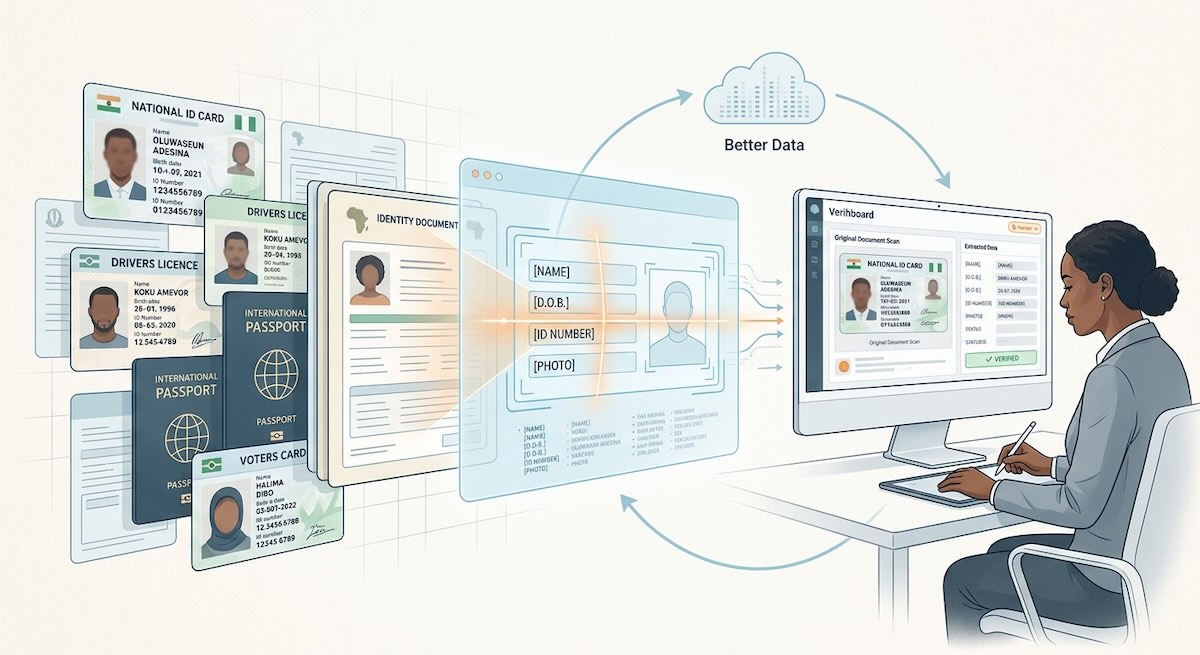
Know Your Customer (KYC) and Know Your Business (KYB) frameworks have quickly become critical pillars of Africa’s rapidly expanding financial services ecosystem. Banks, fintechs, digital lenders, and insurance providers increasingly rely on digital verification to accelerate customer onboarding, drive down operational costs, ensure regulatory compliance, and prevent fraud. To achieve speed at scale, financial institutions are turning to artificial intelligence, deploying optical character recognition (OCR), computer vision, document classification, and facial recognition models to process identity documents in seconds.
However, a fundamental flaw continues to undermine these automated systems: artificial intelligence is only as reliable as the underlying data, context, and domain expertise used to train it. This vulnerability is especially pronounced across Africa, where identity ecosystems are extraordinarily diverse, fragmented, multilingual, and constantly evolving. Standard, off-the-shelf AI tools frequently encounter non-standard document formats, variable image quality, and complex regional scripts that standard algorithms were simply never designed to interpret.
For financial institutions striving to automate identity verification without sacrificing precision, the core challenge is not merely sourcing a more sophisticated algorithm. True efficiency requires building AI systems that natively understand the nuanced realities of African identification. To bridge the gap between automated speed and real-world accuracy, human intelligence remains completely irreplaceable.
The Long Tail of Document Formats
The failure mode isn't a single hard case — it's a long tail of hundreds of valid-but-unfamiliar formats, each individually rare but collectively responsible for a large share of false rejections. A model can be excellent on the top five document types by volume and still reject a meaningful fraction of real customers because their specific issuing authority, card revision, or regional variant never appeared in training.
This is precisely the kind of distribution a purely automated system cannot self-correct on: it doesn't know what it doesn't know. Someone has to look at the rejected document, determine whether it's genuinely invalid or simply unfamiliar to the model, and feed that determination back as a labeled example.
Where Automation Breaks Down
Three points in the pipeline are where automation-only KYC most reliably fails in African deployments:
- OCR and field extraction: handwritten or stamped-over fields, low-contrast scans, and non-standard layouts produce garbled or misaligned field reads that a rules-based validator will either wrongly accept or wrongly reject.
- Face match and liveness: low-light selfies, older ID photos that have visibly aged compared to the applicant, and headwear worn for religious or cultural reasons all push face-match confidence scores into the ambiguous middle band where automated thresholds are least reliable.
- Document classification: a model has to first correctly identify which of dozens of document types it's looking at before it can even apply the right extraction logic, and unfamiliar formats get misclassified before extraction ever starts.
None of these are edge cases in the statistical sense. In many African markets, they describe a substantial share of real onboarding traffic.
Fraud Patterns Only Humans Catch
The fraud side has its own regional character. Synthetic identities assembled from partial, stolen, or fabricated NIN and BVN data are difficult for a classifier to catch when the underlying documents are individually well-formed. On the KYB side, fraudulent or altered CAC certificates, shell companies with plausible-looking but fabricated shareholding structures, and mismatches between a registered business address and its actual operations are the kind of contextual red flags that require someone who understands what a legitimate document from that registry actually looks like — not just whether the image passes a tamper-detection filter.
A model can tell you a document is well-formed. It takes a trained reviewer, familiar with what genuine documents from that specific issuing authority look like, to tell you whether it's real.
The Human-in-the-Loop Model That Works
The pipelines that actually hold up in African markets aren't "automation replacing humans" — they're tiered systems where automation handles the confident majority and routes everything else to trained reviewers. High-confidence document classification, field extraction, and face match clear automatically. Everything below a defined confidence threshold — unfamiliar formats, low OCR confidence, borderline face-match scores, suspected tampering — is routed to reviewers working from versioned guidelines with explicit, region-specific edge-case examples, the same discipline that good annotation guideline design requires more broadly.
This isn't a permanent manual-review tax. Every human decision in that queue is a labeled example. Fed back into periodic retraining, it expands the automated layer's coverage over time, the same way a structured annotation pilot surfaces the gaps in a taxonomy before a project scales. The reviewers aren't a stopgap for a model that isn't good enough yet — they're the mechanism by which the model gets good enough for this specific document population.
The Compliance Layer: CBN, NDPA & Cross-Border AML
Accuracy is only half the requirement — the review process has to satisfy the regulatory frameworks governing how identity data is handled. In Nigeria, the Central Bank's tiered KYC framework sets verification requirements by account tier, with transaction limits rising as more identity evidence is confirmed. Separately, the Nigeria Data Protection Act (NDPA) classifies biometric and government-ID data as sensitive personal data, which means any vendor or annotation partner touching it needs a documented lawful basis, data-minimization practices, access controls, and audit trails — not just a confidentiality clause in a contract.
For institutions operating across borders, this multiplies: each market layers its own data-protection regime and AML requirements on top of local KYC rules. A human review workflow has to be designed with that compliance surface in mind from the start, not retrofitted after an audit finds gaps.
What This Means for Building or Buying KYC Infrastructure
For fintechs and banks evaluating KYC vendors or building in-house, three things follow from all of this:
- Don't assume a vendor's out-of-the-box accuracy holds in your market. Ask for accuracy figures broken down by the specific document types and countries you'll actually onboard against, not global averages.
- Budget for a human review layer as a permanent part of the architecture, not a launch-phase crutch — sized to the confidence-threshold volume you expect, with reviewers trained on your region's specific document variants.
- Work with an annotation and review partner that understands the regional document landscape and the compliance obligations attached to biometric and ID data, so the human layer improves the model over time instead of just processing a permanent backlog.
Bridging the Gap with DataLens Africa
True financial inclusion requires identity verification systems that reflect real-world conditions. Pure automation often falls short when confronted with the vast diversity of African identity documents, but human intelligence bridges that gap.
At DataLens Africa, we help financial institutions, fintechs, and verification platforms train, fine-tune, and scale their KYC and KYB models. By combining enterprise-grade annotation infrastructure with domain-trained African talents across 16+ countries, we deliver the human-validated data required to convert onboarding edge cases into seamless verification experiences.
Ready to reduce onboard drop-offs and elevate your model accuracy? Contact DataLens Africa to explore our custom document annotation and human-in-the-loop verification solutions.