As global enterprises and local startups race to deploy generative AI across Africa, they face a unique, foundational roadblock: localization. Pre-trained frontier models like GPT-5, Llama 4, and Claude are incredibly capable, but they are fundamentally "Western-centric." When tasked with understanding localized nuances, such as South African legal frameworks, Kenyan mobile money behaviors, or conversational code-switching, these models frequently hallucinate or fail entirely.
To bridge this gap, AI engineering teams generally lean on two primary paradigms: Reinforcement Learning from Human Feedback (RLHF) and Retrieval-Augmented Generation (RAG). But for the African continent, where data landscapes are distinct and computing budgets are often constrained, which strategy reigns supreme? Let’s break down how both architectures perform under the specific constraints of the African tech ecosystem.
Understanding the Contenders
Before diving into the regional trade-offs, let's establish what these two methodologies actually do to a Large Language Model (LLM).
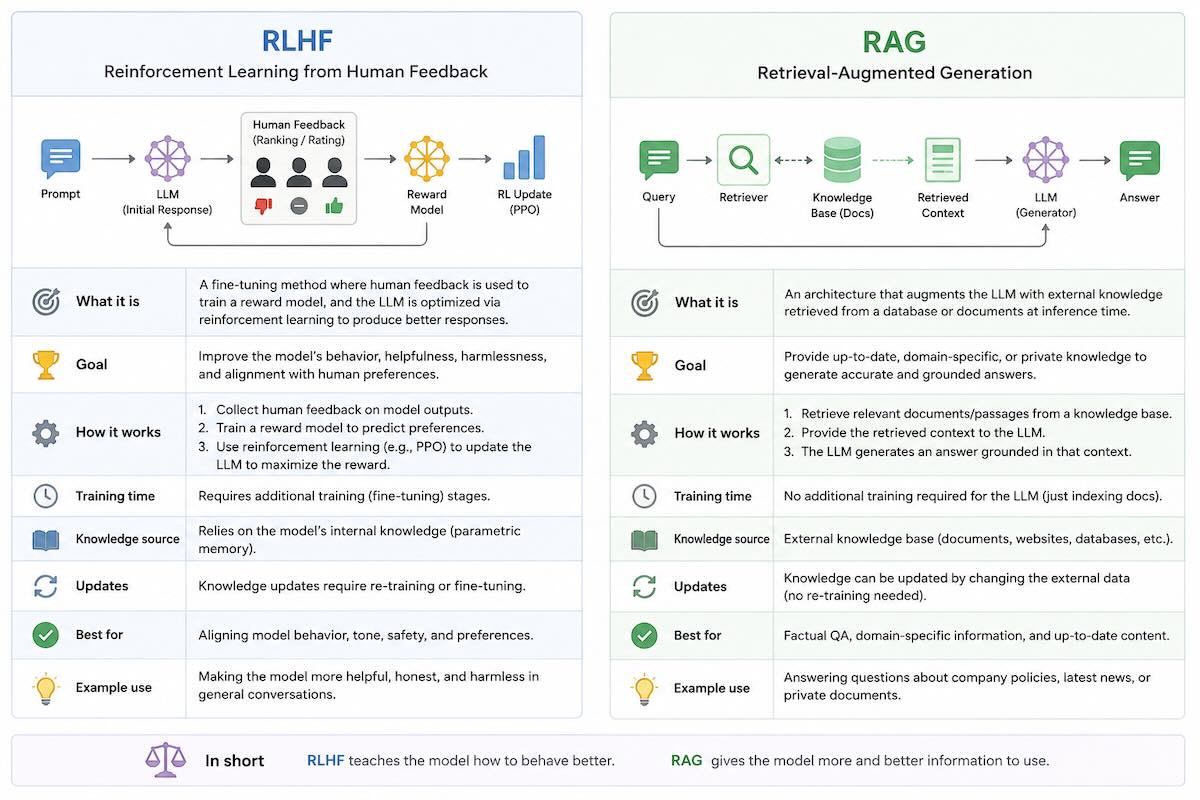
- RLHF (Reinforcement Learning from Human Feedback): This process changes the internal "brain" (weights) of the model. By using human annotators to score and rank model responses, engineers align the AI's behavior, tone, and cultural alignment with human preferences.
- RAG (Retrieval-Augmented Generation): This process gives the model an open-book reference library. Instead of altering the model's weights, RAG connects the LLM to an external vector database containing localized, verified documents. When a user asks a question, the system fetches relevant local context and feeds it into the prompt.
The African Context: 3 Architectural Battlegrounds
1. Handling Low-Resource Languages and Code-Switching
African linguistics are beautifully complex, defined by multi-lingual societies and heavy code-switching (e.g., blending Yoruba and English in a single sentence).
- The RAG Limitation: RAG relies heavily on embedding models to match a user’s query with documents in a database. If your embedding model hasn’t been explicitly trained on localized dialects or code-switched text, the mathematical vectors won’t align, causing the system to retrieve irrelevant data.
- The RLHF Advantage: RLHF relies on native-speaking human annotators who intuitively understand cultural context, slang, and dialect shifts. By aligning the model via human preferences, the LLM learns to natively output responses that sound authentic to a local user.
2. Infrastructure and Compute Deficit
Running AI infrastructure on the continent requires a realistic look at cloud computing costs and GPU availability.
- The RLHF Cost Penalty: Fine-tuning an LLM using RLHF is computationally expensive. It requires substantial GPU power to update model parameters and demands a well-managed pipeline of high-quality human annotators. For many local startups, continuous RLHF cycles are financially prohibitive.
- The RAG Efficiency Win: RAG is significantly cheaper. Because you are not retraining the model, you save massive amounts of compute. You simply pay for the storage and querying of a vector database, making it highly scalable for boot-strapped engineering teams.
3. Regulatory Compliance and the "Right to be Forgotten"
With the rise of robust data protection acts across the continent, such as Nigeria’s NDPA, Kenya’s ODPC, and South Africa’s POPIA, data governance is paramount.
- The RLHF Compliance Trap: Once data is baked into a model's weights via RLHF, it is nearly impossible to selectively "delete" that specific knowledge. If a user exercises their legal right to have their personal or corporate data erased, you cannot easily surgically remove it from the LLM without retraining.
- The RAG Compliance Win: RAG shines in strictly regulated environments. Because the data sits in an external database, compliance is straightforward. If a document needs to be updated or deleted due to POPIA or NDPA guidelines, you simply delete it from your vector database. The next time the model runs, that information is instantly gone.
Best Strategy for Africa
For absolute localization in the African market, choosing one over the other is a false dichotomy. The most successful enterprise AI deployments utilize a hybrid approach.
Comparison at a Glance
| Dimension | RLHF | RAG |
|---|---|---|
| Primary Mechanism | Modifies internal model weights (Fine-Tuning) | Fetches external data dynamically (Prompt Injection) |
| Cost | High upfront: annotator recruitment, training, and quality control across language cohorts | Lower upfront: primarily infrastructure and document curation costs |
| Data Requirements | Requires large, diverse human preference datasets in target languages | Requires a curated, structured knowledge base in the target domain/language |
| Latency | No inference-time overhead once fine-tuned | Adds retrieval latency at query time; depends on index size |
| Accuracy | Strong on tone, cultural nuance, and conversational alignment | Strong on factual grounding; weaker on cultural subtlety |
| Scalability | Hard to scale across many languages simultaneously | Scales well across knowledge domains once architecture is set |
| Maintenance | Requires periodic re-annotation as language usage evolves | Requires ongoing knowledge base curation and refresh |
| Hallucination Control | Reduces general bias and toxic output | Drastically reduces factual hallucinations |
| Best For | Customer-facing products, voice interfaces, nuanced advisory tools | Enterprise knowledge retrieval, compliance systems, document Q&A |
Which Works Best?
If your goal is accurate local knowledge, RAG usually wins first because it is faster to deploy, easier to update, and cheaper than collecting large volumes of preference data. If your goal is better interaction quality, for example, more natural language, safer outputs, or culturally appropriate phrasing, RLHF adds more value.
For Africa specific deployments, RAG is often the practical default because many use cases depend on local documents, policies, extension materials, or business data that can be continuously refreshed. RLHF becomes more important when you have enough expert reviewers in local languages and dialects to produce reliable feedback data.
"Choosing between RLHF and RAG for African AI is not a technical preference. It is a resource allocation decision shaped by language coverage gaps, compute costs, and a regulatory environment that makes data erasure a compliance baseline, not an edge case."
A good rule is:
- Use RAG first for local facts, regulations, prices, agricultural programs, and enterprise knowledge.
- Add RLHF second for tone, safety, helpfulness, and culturally aware behavior, once you have identified a qualified annotation partner capable of recruiting native speakers across your target languages.
- Use both together when accuracy and user trust matter most: RAG reduces hallucinations while RLHF improves alignment.
Looking to build localized AI models that truly understand the African context?
At DataLens Africa, we provide high-quality, ethically sourced data annotation and human-in-the-loop pipelines tailored to regional languages and nuances. Contact us today to supercharge your localization strategy.