
Every AI team eventually hits the same wall: real-world data is expensive, slow to collect, and sometimes legally sensitive to touch. Generative AI offers an appealing shortcut. Point an LLM or diffusion model at a task, describe the distribution you need, and it will manufacture thousands of "training examples" in minutes, no annotators, no field agents, no consent forms.
For African AI teams operating under real budget and timeline constraints, synthetic data looks like a gift. But synthetic data is not neutral. It is generated by models trained overwhelmingly on Western, English-language internet text, and it inherits every gap and bias in that training distribution. When the task is generic, that rarely matters. When the task touches African languages, informal-economy behavior, or regulated domains like finance and law, it matters a great deal, often in ways that only surface after the model is already in production.
What Is Synthetic Data, and Why Are Teams Turning to It?
Synthetic data is any training data manufactured by a generative process, an LLM, a diffusion model, or a rule-based simulator, rather than collected from real people, real documents, or real sensors. In practice, most AI teams encounter it in three forms:
- LLM-generated text: Prompting a frontier model to produce conversations, support tickets, or Q&A pairs that mimic a target domain.
- Diffusion-generated imagery: Generating synthetic photos or documents to augment computer vision datasets, especially for rare classes.
- Simulation-based data: Programmatically generating structured records, transactions, or sensor readings that follow a defined statistical distribution.
The appeal is straightforward: synthetic data is fast, cheap at marginal scale, and sidesteps privacy risk since no real personal data is involved. For teams that need to bootstrap a model before a real data pipeline exists, or that need thousands of adversarial edge cases for stress-testing, it is a genuinely useful tool. The failure mode is not that synthetic data is used, it's that it gets treated as a substitute for real data rather than a supplement to it.
Where Synthetic Data Fails in African Contexts
Synthetic data is a mirror of its generator model's training distribution. For African use cases, that mirror is distorted in three predictable places.
1. Language and Dialect Fidelity
Ask a frontier model to generate "casual conversation in Nigerian Pidgin" or "a customer complaint in Sheng" and it will produce something plausible-sounding, but subtly wrong: textbook grammar where there should be code-switching, formal vocabulary where there should be slang, and an absence of the language mixing that defines how people in Lagos, Nairobi, or Johannesburg actually communicate. Because the generator model has seen relatively little authentic African-language text, it fills the gap with statistically likely, but culturally inauthentic, patterns.
Worse, using this synthetic text to train or fine-tune downstream models risks a compounding effect known as model collapse, where models trained on AI-generated text progressively drift further from the true distribution of human language with each generation. For already low-resource African languages, that drift accelerates faster because there is less authentic data available to anchor against.
2. Cultural and Informal-Economy Nuance
Much of Africa's economic activity happens outside the patterns a generator model has learned from Western internet text: mobile money transfers, informal market bargaining, cooperative savings groups (ajo, chama, stokvel), and multi-generational household purchasing decisions. When asked to simulate this behavior, generative models tend to produce generic, Western-shaped approximations, a "market transaction" that looks like a checkout flow rather than negotiated bargaining, or a "loan request" that assumes credit-bureau data that doesn't exist for the applicant.
This isn't a minor stylistic gap. If a fraud-detection or credit-scoring model is trained on synthetic transaction data that doesn't reflect how mobile money and informal lending actually work in a given market, it will misclassify real, legitimate behavior as anomalous, or miss the actual fraud patterns unique to that ecosystem.
3. Regulated and High-Stakes Domains
Financial, legal, healthcare, and agricultural use cases depend on ground truth that reflects real local conditions: actual regulatory text, real court precedent, real crop disease presentations under local soil and climate conditions, real clinical presentations under local disease prevalence. A generator model can produce a synthetic "loan agreement clause" or a synthetic "maize leaf blight" image that looks plausible, but it cannot originate facts it was never trained on. It can only recombine what it already knows, which for most African regulatory and agronomic specifics, is very little.
This is precisely where synthetic data is riskiest to trust unsupervised, and where ethically sourced, real-world data remains non-negotiable.
Where Synthetic Data Wins
None of this means synthetic data has no place. Used deliberately, it solves real problems that real-world sourcing solves slowly or not at all:
- Volume augmentation for well-covered patterns: Once a model reliably handles a pattern on real data, synthetic variations can multiply coverage around that pattern without additional field collection.
- Adversarial and edge-case generation: Synthetic data is excellent for generating the rare, hard-to-collect edge cases needed for red-teaming and safety evaluation, jailbreak attempts, toxic-content probes, or unlikely-but-critical failure scenarios.
- Privacy-safe test environments: Generating structurally realistic but non-identifying records lets teams build and test pipelines before real, sensitive data is cleared for use.
- Early-stage bootstrapping: Before a full data collection pipeline exists, synthetic data can produce a first, imperfect model to validate product direction, provided everyone understands it's a placeholder, not a foundation.
Synthetic Data vs. Real-World African Data: Comparison at a Glance
| Dimension | Synthetic Data | Real-World African Data |
|---|---|---|
| Source | Generated by an LLM, diffusion model, or simulation | Collected from real people, documents, or environments |
| Cost to Scale | Low marginal cost once a pipeline is set up | Higher marginal cost per sample; requires field operations |
| Speed | Near-instant generation at volume | Slower; bounded by collection and annotation timelines |
| Language & Dialect Accuracy | Weak on code-switching and low-resource languages | Strong when sourced from native speakers |
| Cultural Fidelity | Defaults to generic, often Western-shaped patterns | Reflects actual local behavior and context |
| Regulatory / Domain Accuracy | Cannot originate facts outside generator's training data | Grounded in real local law, clinical, or agronomic conditions |
| Privacy Risk | Low; no real personal data involved | Requires consent and compliance (NDPA, POPIA, etc.) |
| Failure Mode | Model collapse and bias amplification with repeated reuse | Collection bias if sourcing isn't representative |
| Best For | Edge-case generation, augmentation, early prototyping | Ground truth, cultural nuance, regulated domains |
A Practical Framework: Real Data First, Synthetic Data to Scale
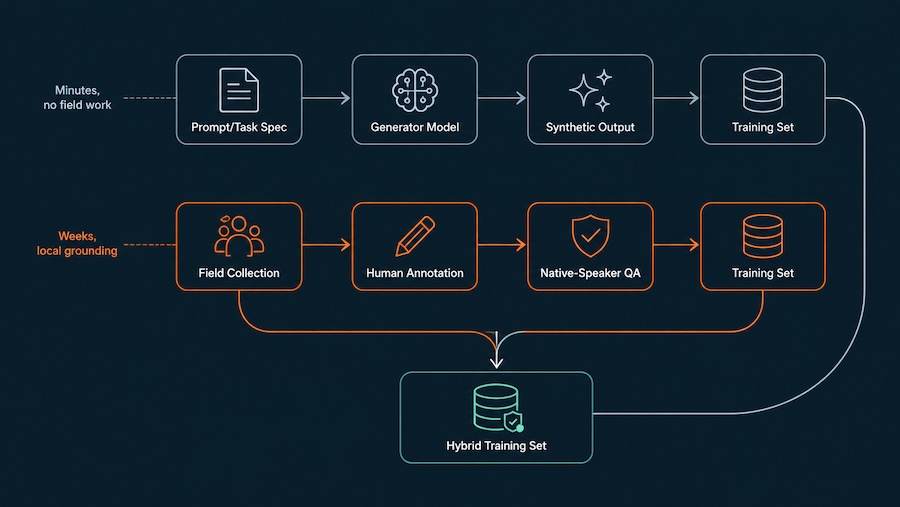
The choice isn't binary. The teams getting this right treat real, locally sourced data as the foundation and synthetic data as a scaling tool layered on top of it, never the other way around.
A practical sequence looks like this:
- Source real data first for the languages, behaviors, and domains that define your product's core use case, ideally through native-speaker collection and annotation rather than scraped or repurposed sources.
- Validate any synthetic data against real benchmarks before it enters a training set, using native-speaking reviewers to catch the subtle cultural and linguistic drift that automated filters miss.
- Use synthetic generation to scale coverage only around patterns already grounded in verified real examples, not to invent coverage for patterns you have no real data on at all.
- Reserve synthetic data for red-teaming and edge cases where the goal is deliberately adversarial, unusual input, not representative, everyday behavior.
Building or evaluating an AI system that needs to actually understand African markets?
At DataLens Africa, we source, annotate, and validate real-world African data, languages, financial behavior, legal and healthcare documents, agricultural conditions, so your models are grounded in truth, not statistically plausible guesses. Contact us today to talk about your data strategy.